



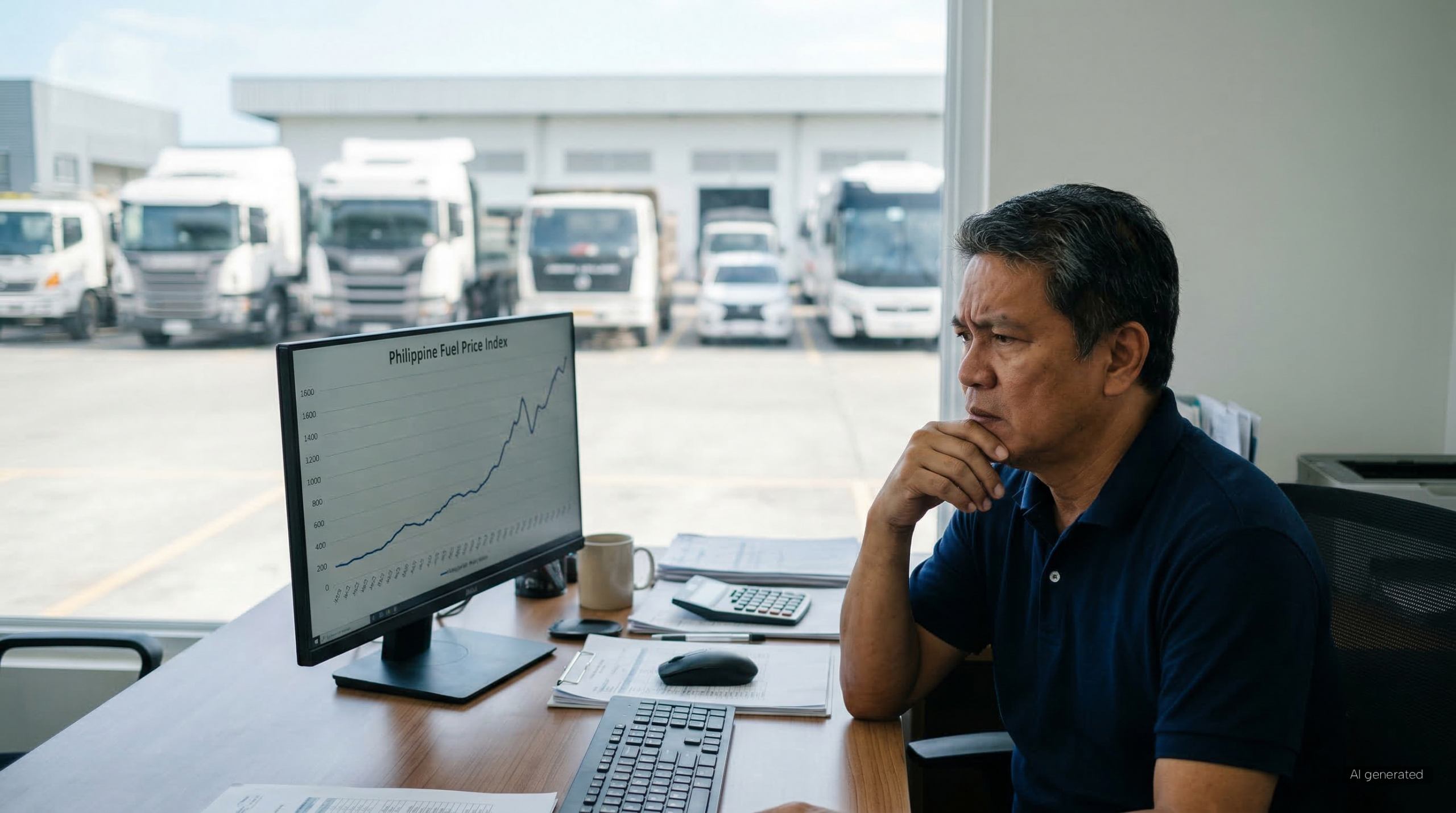
For Philippine fleet operators, staying current with market news is crucial. Yet, even with preparation, a headline like “Diesel prices to hike by P1.50 per liter,” can still be startling.
Fuel costs are a volatile, unpredictable factor. Early in 2026, diesel was stable at ₱54.90 per liter, but emerging international conflicts have since destabilized the market. For a fleet of 20 trucks, even a one-peso increase can significantly impact your monthly profitability.
Table of Contents
The reality remains: you cannot control the price at the pump. Your control lies in managing fuel efficiency- specifically, how much of that expensive diesel your fleet consumes versus how much is wasted.

Image from: Freepik
Bluefocus Infrastructure Advisors study shows that fuel typically accounts for 40% to 60% of a logistics company’s total operating costs in the Philippines.
If you are operating on a “fill up and pray” model, you’re missing out on millions.
We believe that being efficient is the best way to be ahead of the competition. The fleet that uses the least gasoline to carry the most goods is the one that makes the most money, whether the pump price is ₱40 or ₱80. Here is where fuel efficient trucks Philippines and reduce fleet fuel costs strategies matter most.
Read on to discover the four biggest “fuel leaks” hurting your business and the solutions you may apply in order to fix them.
Leak #1: The "Lead Foot" Problem (Driver Behavior)

You may purchase the most modern, aerodynamic vehicle in the world, but if the driver uses the gas pedal like a switch, you’ll waste money.
According to the American Trucking Associations, the difference in fuel consumption between a skilled driver and an aggressive one can be as high as 35%.
In the Philippines, common bad habits include:
- Idling: Leaving the engine running while sleeping or waiting at the pier. (An idling truck burns approx. 2-3 liters per hour for zero km traveled).
- Speeding: Driving at 100kph on TPLEX instead of 80kph increases aerodynamic drag exponentially, torching Scania fuel economy.
Our Solution: Empowering your best fuel saving devices
Ultimately, the single key solution is to move beyond driver blame and focus on driver empowerment.
At BJM, we don’t just hand over the keys of your brand new truck or bus; we also offer Driver Services. Real-time teaching tools, such as the Scania Driver Support system on the dashboard, let drivers get immediate feedback on how to stop, coast, and change gears.
Investing in driver training in the Philippines is highly effective; our data demonstrates that trained drivers consistently achieve a 10% to 12% reduction in fuel consumption. Essentially, a trained driver is your most valuable fuel-saving device.
Leak #2: The "Paihi" Culture (Fuel Theft)

Image from: Freepik
“Paihi” (fuel skimming) is an open secret in the local logistics industry. Whether it’s siphoning a few liters into a kalag (container) at a rest stop or colluding with gas station attendants, fuel theft is a silent killer.
Reports suggest that some Philippine logistics companies lose 5-10% of their fuel volume to pilferage annually. This being said, you’re being robbed of money since you don’t make enough to cover your costs.
Our Solution: Your own Fleet Management System with these main features and benefits
- Fuel Level Monitoring: Our systems include digital fuel sensors that can tell when the fuel level decreases quickly while the engine is off.
- Geo-Fencing: You receive an instant alert if a truck stops in an unauthorized zone (like a known anti-fuel theft Philippines spot on the provincial highway) for more than 10 minutes.
This way, drivers can monitor their vehicle and see if something unusual occurs and if there is, they could immediately come up with a solution to avert it.
Leak #3: The "Soft Tire" Tax (Maintenance)

When was the last time your drivers actually checked their tire pressure with a gauge? We’re not talking about kicking it, but we’re pertaining to measuring it, for real!
According to the US Department of Energy, a mere 10 PSI reduction in tire pressure increases rolling resistance. This negatively impacts your fuel-efficient trucks, reducing your fleet fuel costs savings by 1% to 2%.
Furthermore, under-inflated tires wear out 10% faster. You are burning more diesel to destroy your expensive tires. It’s a double loss.
Our Solution: Adopt the Home Workshop mentality
A helpful approach is to adopt a “Home Workshop” mentality and implement a strict pre-trip inspection policy.
Crucially, selecting the right vehicles can significantly aid this process. Modern Scania and Ashok Leyland trucks, for instance, often feature technologies like TPMS (Tire Pressure Monitoring Systems) or easy-access valves, streamlining the necessary checks.
Leak #4: The Wrong Horse for the Course

Let’s say you’re using a truck with a massive 500HP engine to haul light styrofoam loads or a small engine that has to scream at maximum RPM just to pull a container up Baguio’s Kennon Road.
Over-specifying” (buying too much power) or “under-specifying” (straining the engine) both lead to optimal fuel waste.
Modern Euro-standard engines are not just cleaner; they are designed for cleaner combustion. Scania’s advanced combustion technology lets the engine produce more torque at lower RPMs, which means it doesn’t have to work as hard to carry the load.
Our Solution: Pre-purchase Operational Analysis

We initiate and maintain full transparency on specs when discussing options with prospective truck buyers. Our operational analysis guarantees you select a truck perfectly suited to its intended route and specific use.
For example,
- For flat runs on NLEX/SCTEX: We might recommend a specific rear-axle ratio optimized for cruising speed.
- For mining or mountainous hauling: We prioritize torque and gradeability.
Ultimately, we don’t just sell trucks, we ensure safety and profitability for our stakeholders
At BJ Mercantile (BJM), we are committed to being your long-term, value-driven partner as your fleet and business expand. We empower our customers by providing expert guidance in selecting the ideal vehicle for their specific needs—be it a Scania for its superior fuel economy, an Ashok Leyland for its robust value, or a Thaco for its versatile utility. Opex-wise, we help maximize your savings on fuel costs through the implementation of the right systems and comprehensive training programs.
So, when fuel prices rise, remain calm. Focus on three elements: Your dashboard, your drivers, and your maintenance logs. These are crucial for fuel efficient trucks in the Philippines and for significantly reducing overall fleet fuel costs, which could lead to millions in savings for your business over time!
Download your FREE Refueling Log Sheet Template
Type your email address below so we can send the file straight to your inbox:
Your free guide is on the way!
Your requested PDF is on its way to your inbox! We've also added you to our newsletter so you can stay up-to-date with our latest news. If you ever change your mind, you can easily opt out by clicking the unsubscribe link at the bottom of any email. Thanks for downloading!
References:
- Effects of Fuel Price Increase on Operating Cost of Freight Transport – International Journal of GEOMATE.
- Philippines Diesel Prices & Trends 2026 – GlobalPetrolPrices.com / DOE Philippines.
- Energy Company Insider Theft Case Study – Clearspeed.
- Improving Driver Behavior to Maximize Fuel Economy” – American Trucking Associations / Zonar.
- “Tire Pressure and Fuel Consumption” – North American Council on Freight Efficiency (NACFE).
- “Analysis of Logistics Costs for Imported and Domestic Containers in the Philippines” – Stratbase Institute.
Comments are closed